Mastering Mental Clarity and Focus: Your Complete Guide
In today's fast-paced world, maintaining mental clarity and focus has become increasingly challenging. With constant notifications, overflowing to-do lists, and information overload, the mind often feels scattered and overwhelmed — yet clear thinking is essential for productivity, decision-making, and overall well-being. This guide offers practical steps, a 7-day plan, and evidence-based habits to boost your cognitive function and reclaim mental sharpness.
Plus: discover a simple 7‑second reset many users report helps restore clarity — described by some as "Scientists Stunned by 7‑Second Brain Trick That Attracts Success With No Effort." This phrasing is used to highlight user reports and should not be read as a guaranteed scientific claim. Want fast support for focus? Learn how Neuro Energizer may help — discover it here: https://www.digitalightment.com/wealth-activation
Understanding Mental Clarity and Focus

Person meditating with a clear mind, representing mental clarity and focus, calm mind, focused brain
Mental clarity means your thoughts flow smoothly and you can process information quickly and accurately. Focus is the ability to give sustained attention to a single task without distraction. Together, mental clarity and focus form the foundation for efficient thinking and better cognitive function.
Having strong mental clarity and focus lets you:
Make better decisions with confidence
Solve problems more effectively
Complete tasks more efficiently
Learn and retain new information more reliably
Reduce stress and mental fatigue
Boost mental clarity for sharper day-to-day performance
When your mind is clear and your brain is focused, you operate at your cognitive best. For example, when you can think clearly, you make faster, more accurate decisions in meetings or while planning your day. This mental state improves work performance and enriches other areas of life—relationships, creativity, and personal well‑being.
If you need immediate support to boost mental clarity, learn about Neuro Energizer here: https://www.digitalightment.com/wealth-activation
Common Obstacles to Mental Clarity and Focus
Before diving into solutions, it's important to understand what might be hindering your cognitive performance. Identifying these obstacles is the first step toward overcoming fog and regaining sharper thinking.

Person overwhelmed by digital distractions affecting mental clarity and focus
Digital Distractions and Information Overload
Research estimates that many people check their phones dozens of times per day. Each ping or notification interrupts your attention, fragments focus, and makes deep work harder to achieve. For example, checking email mid-task increases errors and slows progress on complex work.
We also consume far more information than previous generations. The resulting information overload can cause decision fatigue and mental exhaustion, leaving you with reduced mental clarity and slower processing of new information.
Multitasking and Task Switching
Multitasking is actually rapid task-switching. Each switch forces your brain to reorient, reducing efficiency and increasing mistakes. When you try to juggle multiple tasks, attention suffers, and fatigue accumulates—so single-tasking produces better results for most cognitive tasks.

Person trying to multitask with various activities showing mental strain
Poor Sleep Quality and Quantity
Sleep is when the brain consolidates memory, clears metabolic waste, and recharges. Insufficient or poor-quality sleep harms cognitive function—making it harder to concentrate, process information, and solve problems. Even one bad night can leave you feeling foggy the next day.
If chronic sleep issues are affecting your clarity, consider addressing sleep habits and consulting a provider. Some people also use targeted supports for morning energy and focus; learn more about Neuro Energizer here: https://www.digitalightment.com/wealth-activation
Chronic Stress and Anxiety
Chronic stress elevates cortisol levels and can impair brain regions responsible for executive function and attention. Over time, prolonged anxiety and stress contribute to mental fatigue, reduce working memory capacity, and make it harder to sustain focus and clear thought.
Poor Nutrition and Dehydration
The brain uses a large share of the body's energy, so poor diet and low hydration quickly manifest as fog, low energy, and impaired attention. Even mild dehydration can impair cognitive performance and increase fatigue.
Small nutritional supports and consistent hydration can help restore clarity—learn more here: https://www.digitalightment.com/wealth-activation

Healthy brain foods contrasted with processed foods affecting mental clarity
Sedentary Lifestyle
Regular physical activity boosts blood flow to the brain and promotes factors that support neural health. A lack of movement is linked to reduced cognitive function and energy. Short movement breaks and regular exercise help clear mental fog and improve focus.
Environmental Factors
Your surroundings matter. Clutter, poor lighting, uncomfortable temperatures, and noisy environments create distractions that sap attention and worsen brain fatigue. Simple environmental fixes—decluttering, better light, and a comfortable workspace—can noticeably improve clarity.
Practical Strategies to Enhance Mental Clarity and Focus
Now that we understand the obstacles, here are evidence-based techniques to improve cognitive function and reduce mental fog. These practical strategies target the root causes of reduced clarity and provide steps you can implement in your daily routine.
Environmental Adjustments

Organized, clutter-free workspace optimized for mental clarity and focus
Optimize Your Workspace
Your physical environment directly affects attention and clarity. Create a dedicated workspace that signals to your brain it's time to focus:
Clear clutter from your desk and desktop to reduce visual distractions
Maximize natural light where possible; add task lighting if needed
Keep a comfortable temperature (around 68–72°F) to limit discomfort-related distraction
Use noise-canceling headphones or white noise to block interruptions
Add a plant or two — some studies suggest plants can modestly improve concentration (research varies)
Digital Detox Strategies
Reclaim attention from digital overload with simple rules:
Disable non-essential notifications and put devices on do-not-disturb during focus blocks
Use focus apps like Freedom or Forest to block distracting sites and apps
Follow the 20-20-20 screen rule: every 20 minutes, look 20 feet away for 20 seconds to reduce eye strain
Batch email and social checks into set times to limit task switching
Keep devices out of the bedroom to protect sleep quality

Person implementing digital detox by turning off notifications on devices
Cognitive Techniques
Mindfulness and Meditation
Brief, regular mindfulness strengthens attention and reduces mind-wandering. Even short daily practices can help you process information more effectively:
Start with guided apps like Headspace or Calm to build a habit
Try mindful breathing—focus on your breath for 3–5 minutes (or use a 4-4-4 box-breathing pattern)
Do a 5-minute body scan or 5-minute mindful walking as an alternative to seated meditation
Insert mindful moments into your day (mindful eating, a focused walk) to reset attention
Quick micro-protocol (try now): inhale for 7 seconds, hold for 1 second, exhale for 7 seconds — repeat 2–3 times as a 7‑second-style reset, which many people find helps restore attention. (This is experiential and not a guaranteed medical treatment.)

Person practicing mindfulness meditation for improved mental clarity
Single-Tasking and Deep Work
Train deeper concentration with structured focus sessions:
Use the Pomodoro Technique: 25 minutes focused work + 5-minute break to build sustained attention
Reserve 90–120 minute "deep work" blocks for complex tasks when possible
Limit multitasking—finish one task before starting the next to avoid costly task switching
Use the two-minute rule for quick tasks to prevent small things from interrupting deep work
Brain Training Exercises
Keep your brain engaged with variety and challenge:
Learn a new language or instrument to create novel cognitive demands
Solve puzzles, play strategy games, or use brain-training apps to challenge executive function
Read demanding material to practice sustained attention
Practice recall exercises—memorize, then retrieve to strengthen memory processes

Person engaged in brain training activities for mental clarity
Lifestyle Foundations
Sleep Optimization
Quality sleep is non-negotiable for mental clarity and long-term brain health. Improve sleep hygiene with these steps:
Keep a consistent sleep schedule, even on weekends
Create a relaxing pre-bed routine to signal your brain it's time to wind down
Keep the bedroom cool (65–68°F), dark, and quiet
Avoid screens 1–2 hours before bed to protect melatonin production
Limit late caffeine and evening alcohol
For targeted morning energy and clearer mornings, some people explore safe supplements alongside habit changes — see Neuro Energizer: https://www.digitalightment.com/wealth-activation (Individual results vary; consult your healthcare professional.)

Peaceful bedroom setup optimized for quality sleep and mental clarity
Nutrition for Brain Health
Fuel your brain with nutrient-dense foods to support clarity, memory, and energy:
Include omega-3 sources (fatty fish, walnuts, flaxseeds) for cell structure and signaling
Eat antioxidant-rich foods like berries and colorful vegetables to reduce oxidative stress
Balance quality proteins with complex carbohydrates (whole grains) for steady energy
Consider Mediterranean or MIND-style diets linked to better cognitive outcomes
Limit added sugars and processed foods that can contribute to brain fog
Hydration
Even mild dehydration impairs cognitive performance. Practical hydration tips:
Aim for regular water intake throughout the day—adjust based on activity and climate
Start your day with a glass of water to jump-start circulation and alertness
Use a marked water bottle or set reminders to track intake
Limit dehydrating beverages like excessive caffeine and alcohol

Various hydration options and brain-healthy foods for mental clarity
Physical Exercise
Regular movement supports blood flow, mood, and cognitive resilience:
Aim for at least 150 minutes of moderate exercise per week (public-health guidance)
Mix aerobic activity with strength training for broad benefits
Try short high-intensity intervals (HIIT) if appropriate for your fitness level
Take micro-breaks to stand, stretch, or walk to break up long sedentary periods
Consider mind-body practices like yoga or tai chi to combine physical activity with stress reduction

Person exercising outdoors, demonstrating physical activity for mental clarity
Task and Information Management
Brain Dumps and External Storage
Reduce cognitive load by getting information out of your head:
Do regular brain dumps—write down thoughts, tasks, and ideas to free working memory
Use a trusted system (digital or analog) for capturing and organizing information
Try Cornell notes, mind maps, or a Zettelkasten-style second brain to store and retrieve information
Prioritization Frameworks
Apply simple frameworks to focus on what matters most:
Eisenhower Matrix to separate urgent from important
Time blocking to reserve specific windows for focused work
MIT method—select 1–3 Most Important Tasks each day
The 1-3-5 Rule: 1 big, 3 medium, 5 small tasks to limit overwhelm
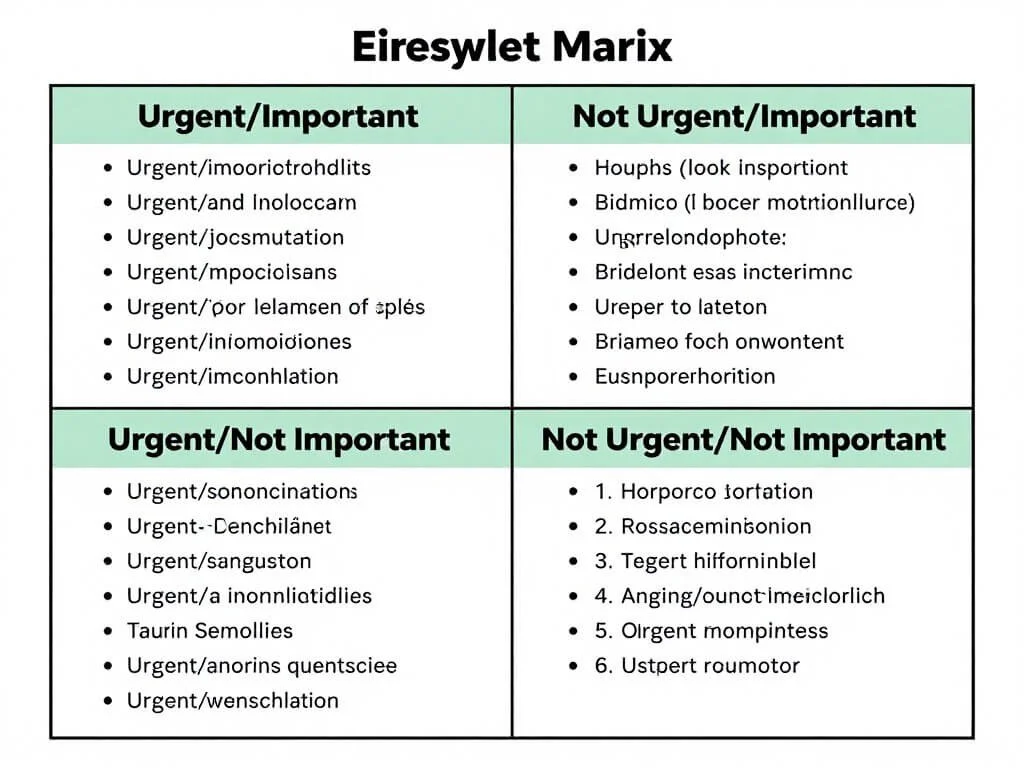
Eisenhower Matrix prioritization system for mental clarity and focus
Information Consumption Diet
Be intentional about what and when you consume information to protect attention:
Practice selective ignorance—not all information deserves your attention
Implement information fasting periods (for example, no news before noon)
Ask: Is this information useful, accurate, and necessary before consuming?
Batch your information intake into designated times to avoid constant context switching.
Supplements and Tools for Enhanced Clarity
While lifestyle changes are the foundation for mental clarity and long-term brain health, targeted supplements and the right tools can provide additional support for cognitive function, energy, and stress management. Always consult a healthcare professional before starting any supplement regimen and check ingredients and third-party testing for quality.
Evidence-Based Supplements

Various natural supplements known to support mental clarity and focus
Omega-3 fatty acids: Support brain cell structure and communication (research suggests cognitive benefits)
B vitamins: Essential for energy production and neurotransmitter synthesis (necessary for mental energy)
Magnesium: Supports neural plasticity and learning (may aid sleep and reduce anxiety)
Adaptogens (Ashwagandha, Rhodiola): Can help manage stress response and reduce feelings of fatigue
L-theanine: Promotes calm alertness and improves focus (commonly found in green tea)
Some people use targeted supplements, such as Neuro Energizer, alongside lifestyle changes. If you consider product options, review ingredient lists, look for third-party testing, and consult your provider. Learn more about Neuro Energizer and current offers: https://www.digitalightment.com/wealth-activation (Individual results vary.)
Productivity Tools and Apps
Technology can be both a distraction and a solution. These tools help manage attention, reduce cognitive load, and support daily routines that boost mental clarity:
Focus apps: Forest, Freedom, Focus@Will — useful for blocking distractions and protecting deep work time
Task management: Todoist, Asana, Notion — keep tasks off your mind and organized
Note-taking and external storage: Evernote, Obsidian, Roam Research — build a reliable second brain
Mindfulness and meditation: Headspace, Calm, Insight Timer — support mindfulness meditation practice
Time tracking: Toggl, RescueTime — identify where attention is being lost
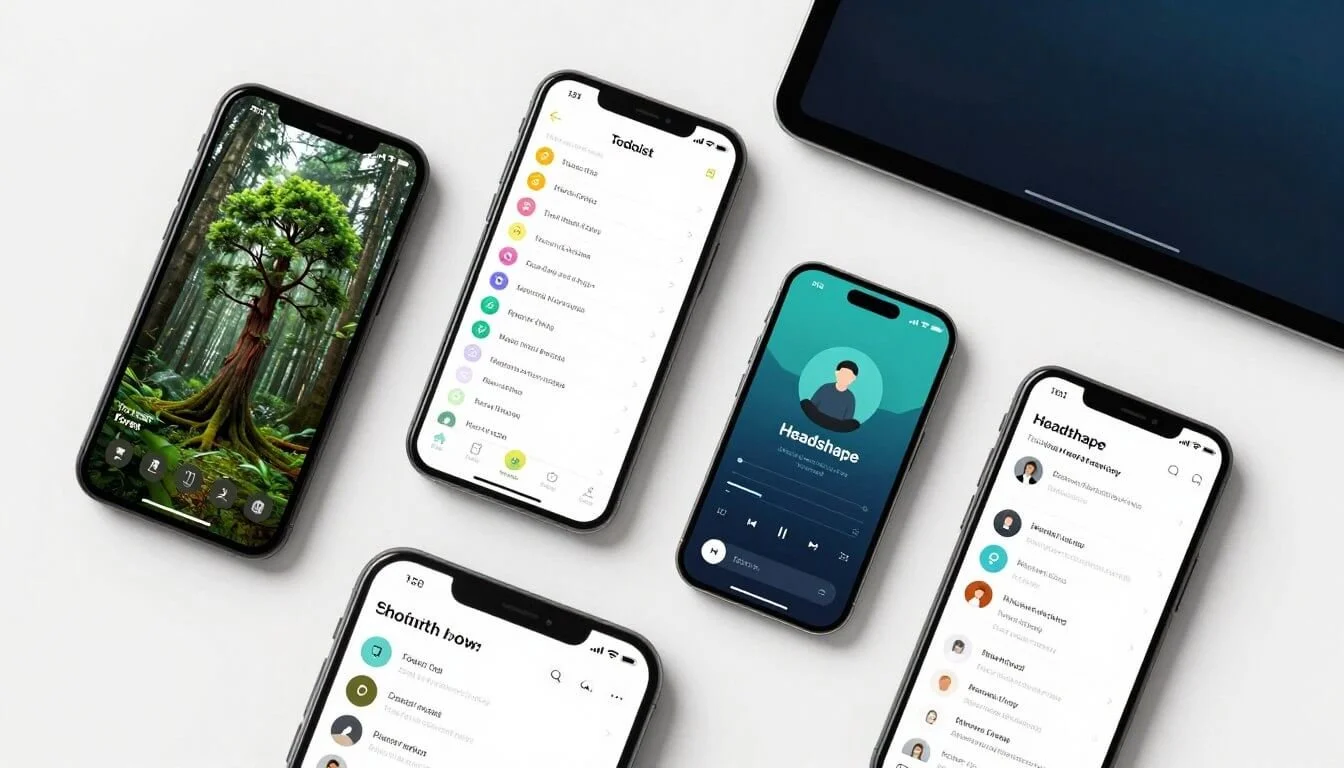
Productivity apps and tools displayed on digital devices
Mental Clarity in Different Contexts
Different situations call for tailored approaches to protect attention, process information efficiently, and sustain clarity throughout the day.
Workplace Focus

Professional in a focused work state in an optimized office environment
Maintain clarity in high-pressure work environments by protecting blocks of uninterrupted focus time. Quick micro-routine: before a focus block, take 1 minute to slow-breathe and drink a glass of water to prime attention.
Set "focus hours" with no meetings or interruptions to protect deep work
Use the "touch it once" principle for email and small tasks to reduce context switching
Schedule strategic breaks (e.g., 5–15 minutes every 90 minutes) to reduce fatigue
Leave short "ready-to-resume" notes so you can restart quickly after interruptions
Establish clear availability boundaries with colleagues to guard attention
For busy professionals seeking improved focus, see Neuro Energizer: https://www.digitalightment.com/wealth-activation
Academic Performance
Optimize studying and memory by using evidence-based learning routines. Quick micro-routine: before a study block, do 60 seconds of deep breathing and sip water.
Use spaced repetition (research supports its effectiveness) to improve long-term memory.
Prefer active recall over passive review to strengthen retrieval
Apply the Feynman Technique—explain concepts to test understanding
Study in focused 25–50 minute blocks with short breaks to maintain concentration
Vary study locations to enhance memory encoding

Student using active study techniques for better mental clarity
Creative Thinking
Foster creative clarity by alternating focused effort with relaxed, diffuse thinking. Use techniques that encourage idea connection and divergent thought.
Schedule diffuse-thinking time (walks, showers, daydreaming) to incubate ideas.
Use mind mapping to explore connections between concepts
Try constraint-based creativity—limit time or resources to boost inventive thinking
Practice "morning pages" (stream-of-consciousness writing) to clear your mind
Alternate focused work with relaxed ideation to balance productivity and inspiration
Across contexts, small routines and environmental tweaks add up—protecting focus, managing tasks, and giving your brain the rest it needs for clarity and better thinking.
Troubleshooting Persistent Mental Fog
If you've implemented the strategies above and still struggle with mental clarity, consider these potential underlying issues. Persistent fog can signal treatable problems—identifying the cause is the key to getting adequate help.

Person consulting with healthcare professional about mental clarity issues.
When to Seek Professional Help
Consult a healthcare provider if you notice any of the following signs, especially if they are new, severe, or worsening:
Sudden or severe changes in cognitive function (confusion, trouble speaking, sudden weakness)—seek urgent care for stroke-like symptoms
Persistent brain fog that doesn't improve after lifestyle changes
Mental clarity issues accompanied by other concerning symptoms (weight changes, persistent headaches, fainting)
Cognitive difficulties that interfere with daily functioning—work, school, or self-care
Family history of neurological conditions that could increase risk
Potential Underlying Causes
Mental fog can be associated with many health issues. These possibilities merit evaluation rather than assuming a single cause:
Hormonal imbalances (thyroid dysfunction, menopause-related changes)
Nutrient deficiencies (B12, iron, and vitamin D) that affect brain energy and memory
Sleep disorders (sleep apnea, severe insomnia) that reduce sleep quality and daytime cognition
Chronic conditions (fibromyalgia, autoimmune disorders) that contribute to fatigue and cognitive problems
Medication side effects or interactions that impair attention and clarity

Medical test results being reviewed for underlying causes of mental fog.
If you suspect treatable causes, such as nutrient deficiencies or sleep disorders, consult your healthcare provider for testing and guidance. After medical clearance, some people consider adjunct supports—such as Neuro Energizer—to help with energy and clarity: https://www.digitalightment.com/wealth-activation (Individual results vary; consult a healthcare professional.)
Ready to act? If you want to move from troubleshooting to routine, jump to the 7-Day Mental Clarity Action Plan in the article (see the section with the same title) to try targeted daily steps that can improve focus and brain quality over time.
Your 7-Day Mental Clarity Action Plan
Start improving your mental clarity today with a simple, progressive plan you can follow in small daily steps. Each day builds on the previous one, so you form sustainable habits that boost focus and brain energy.
7-day calendar showing mental clarity action plan steps.
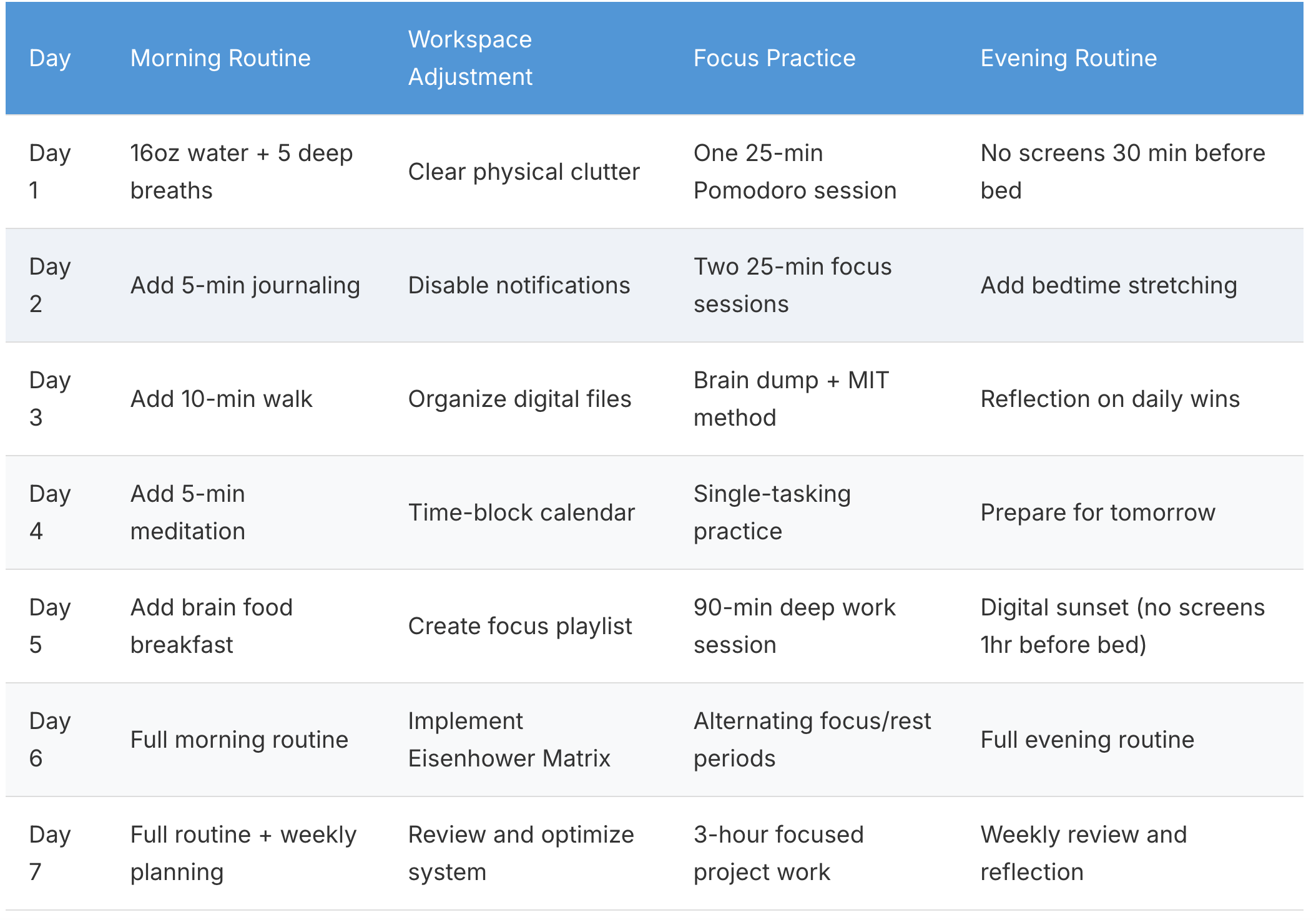
Why these steps help: water and breathing prime alertness, decluttering reduces visual distractions, focused minutes build attention stamina, and a consistent daily routine trains your brain to process information more efficiently. Small, repeatable actions compound into lasting clarity.
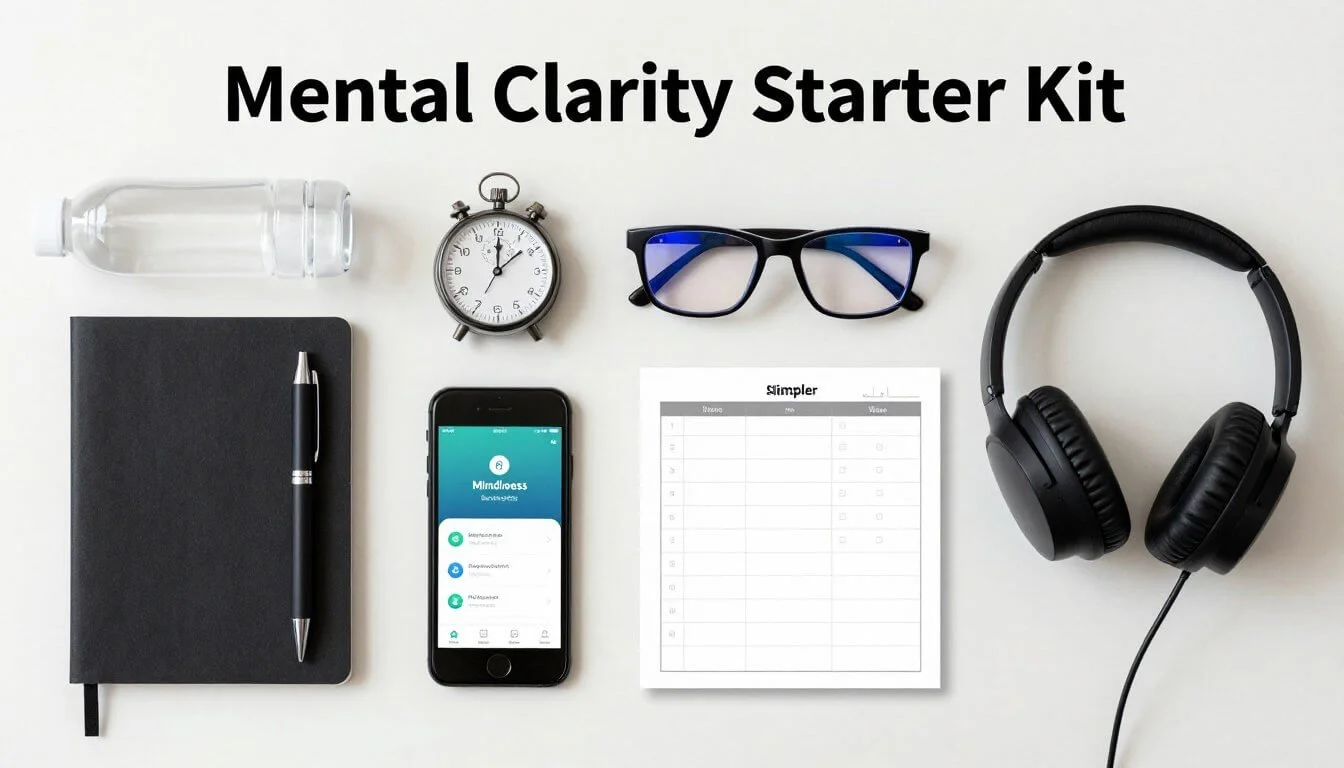
Mental Clarity Starter Kit
These essential tools will help you implement your action plan:
Dedicated notebook for brain dumps and journaling
Timer for Pomodoro sessions (25-minute blocks work well)
Water bottle with time markers to track regular hydration
Blue-light blocking glasses for evening use to protect sleep quality
Noise-canceling headphones or earplugs to protect during deep work time
Mindfulness app (free options available) for daily practice
Task management system (digital or analog) to capture tasks and reduce mental load
Embracing the Journey to Mental Clarity
Improving mental clarity and focus isn't a destination but an ongoing practice. Some days will be clearer than others, and that's perfectly normal. The key is consistency with the fundamentals—quality sleep, proper nutrition, regular exercise, stress management, and mindful attention training—to support long-term brain health and daily clarity.
Remember that small, consistent actions compound over time. You don't need to implement every strategy at once. Start with one or two routines that fit your life and build from there. Your brain is remarkably adaptable, and with steady practice, maintaining mental clarity will become more natural.
The benefits extend far beyond productivity. When your mind is clear and your focus is steady, you experience greater peace, make better decisions, and engage more fully with life. Improved clarity supports creativity, stronger relationships, and greater resilience in the face of challenges.
Many people find an immediate boost in clarity from a short mental reset; some users describe a simple 7-second practice as transformative—framed by others as "Scientists Stunned by 7-Second Brain Trick That Attracts Success With No Effort." This wording highlights user reports and should not be interpreted as a guarantee of scientific outcomes. If you're curious, learn more about Neuro Energizer here: https://www.digitalightment.com/wealth-activation (Individual results vary; consult your healthcare provider.)